The question of whether to stay inside Amboseli National Park or outside its boundaries is more consequential than it might appear. It is not just a location decision. It shapes the rhythm of your entire visit: when you can drive, how you structure your days, how integrated the safari feels, and how much of your time goes toward logistics versus actual time in the park. Getting this right for your specific trip type matters, and the answer is not the same for every visitor.
The short version: inside-the-park lodges give you better game-drive access and a more immersive experience. Outside-the-park stays can offer different landscapes, alternative pricing structures, and in some cases access to conservancy areas with their own wildlife character. Neither is universally superior. The right answer depends on what you are optimising for.
What Staying Inside the Park Actually Changes
The most tangible difference between an inside-the-park stay and an outside stay is gate timing. Amboseli National Park has a set opening and closing schedule, and visitors staying outside the boundary need to factor this into their daily planning. For morning drives, this means either arriving at the gate right as it opens and losing the pre-sunrise window, or getting special permission for early entry, which not all camps arrange as a standard service.
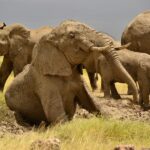
Inside-the-park lodges bypass this entirely. You are already in the protected landscape when you wake up. There is no gate to reach before you can begin. This means your vehicle can leave camp before sunrise and be positioned at the swamp margins in the first light of dawn, which is genuinely the highest-yield time for both elephant viewing and Kilimanjaro photography. That window before the sun fully rises, when the mountain glows and the herds are active, is the specific thing that inside-the-park accommodation protects.
The same logic applies in the evening. Sunset drives do not end with a race to exit before the gate closes. You can stay until the last of the light fades over the plains, return to camp at your own pace, and the evening does not carry the slightly compressed feeling that gate-closing pressure creates.
For visitors whose priority is getting the maximum from every morning and evening, this practical difference is significant.
The Immersion Factor
Beyond gate timing, there is a quality-of-experience argument for inside-the-park accommodation that is harder to quantify but easy to feel on the ground. When your tent or lodge room is inside the protected landscape, the safari does not begin and end with game drives. Elephants occasionally walk close to or through some lodges. The sounds of the ecosystem are present overnight. The visual context of the park is your constant surround rather than something you travel to reach.
This immersive quality matters differently to different visitors. For some, it is central to why they chose Africa for a trip in the first place: the sense of being genuinely inside the wild rather than adjacent to it. For others, who are perfectly happy retreating to a comfortable outside-the-park lodge in the evenings and focusing their park time on structured drives, the immersion factor is a nice-to-have rather than an essential.
There is no universally correct position here. What matters is knowing which kind of traveller you are before you make the accommodation decision.
Game-Drive Rhythm: Where Inside Lodges Shine
The strongest case for inside-the-park accommodation is built on game-drive efficiency. In Amboseli specifically, where the most productive wildlife viewing happens in the early morning around the swamp system and the best Kilimanjaro views require pre-sunrise positioning, the ability to depart before dawn without gate complications is a genuine advantage.
Think about a three-night stay in which you want three clean dawn drives. With an inside-the-park lodge, all three drives can begin before first light, positioning you optimally for both the mountain and the elephant activity that characterises early morning in the swamp areas. With an outside stay that requires gate access, your departure time is constrained, and the first 30 to 45 minutes of the best light of the day can be spent in transit rather than in the field.
Across three mornings, that difference accumulates. For a photography-focused trip where those early minutes carry particular value, inside-the-park accommodation is clearly the more strategic choice.
Who Benefits Most from Inside-the-Park Lodges
Certain visitor profiles get a disproportionate benefit from staying inside Amboseli National Park:
First-time visitors benefit because the experience matches the mental image they carried into the trip. Being inside the park from arrival, with wildlife present and the swamps visible from the lodge grounds, creates the specific sense of immersion that many people travel to Africa to find. It also simplifies the emotional story of the trip: you arrived, you were there, it felt like a safari. This may sound abstract, but it consistently shapes how first-time visitors rate their experience.
Photographers benefit because dawn access is unconstrained and evening drives do not end under gate-time pressure. The additional minutes at either end of the day, when the light is at its most compelling, represent real gains in usable shooting time. For anyone whose primary goal is the classic elephant-and-Kilimanjaro image, inside-the-park positioning maximises the number of quality attempts.
Families with children benefit from the reduced transit friction. Fewer road transfers between accommodation and the gate mean less time managing tired or impatient children in vehicles, and the ability to move between camp rest and game drives without navigating external roads simplifies the daily structure considerably.
Short-stay visitors benefit proportionally more than longer stays. If you have only two nights in Amboseli, every hour counts. Inside-the-park accommodation means neither morning begins with a gate delay. For visitors squeezing Amboseli into a tight multi-destination itinerary, that efficiency matters.
Where Outside-the-Park Stays Make More Sense
It would be misleading to suggest that inside-the-park lodging is automatically the right choice for every visitor. There are specific situations where staying outside the park boundary is the more logical option.
Some of the most interesting accommodation options in the Amboseli ecosystem sit outside the park on private land and community conservancies. These properties offer different experiences: sometimes more exclusive, sometimes with game drives that are not constrained by park rules around vehicle behaviour, and in some cases with access to landscapes that look and feel quite different from the national park interior. A conservancy stay north of the park, for example, might offer night game drives and more flexible off-road access that an inside-the-park lodge legally cannot provide.
Budget is also a legitimate factor. Some outside-the-park options are priced more accessibly than the established inside-the-park lodges, and for visitors where rate management is a real constraint, a strong outside stay is better than a stretched-budget inside stay.
Route logic matters too. Some itineraries approach Amboseli from directions or with onward connections that make an outside stay considerably more convenient. If the practical arithmetic of your trip points toward an outside location, that is a valid reason to choose one.
A Practical Comparison
| Factor | Inside-the-Park Lodges | Outside-the-Park Stays |
|---|---|---|
| Early morning drive access | No gate constraints | Gate timing applies |
| Evening drive flexibility | Stay until last light | Gate-close pressure exists |
| Immersion and wildlife proximity | High | Variable |
| Night game drives | Not permitted | Available at some conservancies |
| Off-road driving | Not permitted | Available at some conservancies |
| Price range | Generally higher | Wider range available |
| Suitability for first-timers | Strong | Depends on specific property |
| Suitability for photographers | Excellent | Good, with some constraints |
The Specific Lodges Worth Knowing About
Inside Amboseli National Park, the main established lodge zones cluster around the Ol Tukai area and the Enkongo Narok swamp margins. Amboseli Serena Safari Lodge and Ol Tukai Lodge are among the longest-established inside-the-park options and both deliver the classic immersive Amboseli experience with strong positioning for early swamp-margin drives. Amboseli Sopa Lodge is further from the centre but offers a different perspective on the park’s eastern areas.
These properties vary in character, price point, and what they emphasise in the guest experience. The shared advantage is position: all of them give you the game-drive freedom that is the core argument for staying inside the park.
Outside the park, properties in the Kimana, Mbirikani, and Selenkay conservancy areas offer alternative experiences. Some of these deliver genuinely excellent safaris with the added flexibility that private land allows. They are worth considering for repeat visitors who have already done the classic inside-the-park experience and want to explore the ecosystem from a different angle.
Practical Notes for Planning Your Stay
The question of inside versus outside should be resolved before other accommodation decisions, because it narrows the field meaningfully and prevents the confusion of comparing properties that are not actually competing for the same visitor type.
If your priority list starts with early morning access, maximum immersion, and a classic Amboseli safari feel, start with inside-the-park options. If your priority list includes night drives, off-road flexibility, conservancy access, or a specific camp character that happens to sit outside the boundary, start there instead.
For most first-time visitors with no specific constraints pointing toward an outside stay, inside-the-park lodging is the stronger recommendation. The immersion and game-drive rhythm advantages are most meaningful for visitors who are experiencing Amboseli for the first time and want the experience to deliver on its full promise.
Duration recommendations: two nights is the functional minimum inside the park for visitors fitting Amboseli into a broader Kenya circuit. Three nights gives meaningfully better returns for photographers and anyone making Kilimanjaro views a priority. Four nights is typically only worth considering for dedicated photography projects or an intentionally slow-paced lodge experience.
Where to Go Next
For broader Amboseli planning context, including when to visit and what to expect across different months, guides at touringinsights.com cover the seasonal and logistical picture in detail.
Specific camp recommendations, current availability, and the question of whether inside or outside better fits your particular itinerary are things that field-based operators can answer more precisely than any general guide. trunktrailssafaris.com has active knowledge of the current state of Amboseli accommodation options and can match the right location to your specific trip structure.
Prefer a different route, budget, or travel style? This plan can be adapted to fit.
Customise Your Trip